Geography Class 32
Brief Discussion on the Previous Class (5:13 PM)
Currents of the South Atlantic Ocean (5:22 PM)
- South equatorial current, which moves along Brazil forms the Brazilian current. It is a warm current.
- The Brazilian current gets deflected towards the left in the southern hemisphere (Due to Coriolis force) and joins the West Wind Drift.
- West Wind Drift is a cold current, which circulates the continent of Antarctica. (It flows under the influence of Westerlies).
- The Brazilian current once when comes under the influence of West wind drift is called South Atlantic Drift.
- Near the coast of Africa, it turns upward and is known as Cold Benguela Current.
- Benguela current is responsible for the formation of the Namib and Kalahari Deserts.
- Cold Benguela current joins the South Equatorial current.
- Falkland Current flows along the eastern coast of the South American continent.
- Gyre is formed in the South Atlantic Ocean,
Currents of the Pacific Ocean (5:34 PM)
- North Equatorial current gets divided by the archipelago and turns rightward. This current is known as Warm Kuroshio Current (along the coast of Japan).
- It is a warm current moving along the coast of the Philippines and Japan.
- The North Pacific Current is an ocean current that flows west-to-east between 30 and 50 degrees north in the Pacific Ocean.
- It gets divided near the North American Continent.
- One branch moves upward and is known as Warm Alaskan Current.
- Another branch moves southward and is known as the cold California Current.
- Cold California Current joins the North Equatorial Current. therefore a gyre is formed here.
- Near Sakhalin Island, there are two cold currents- Oyashio Current and Okhotsk Current.
Southern Pacific Ocean
- The southern equatorial current moves down and is called Warm East Australian Current.
- Coming down, it joins West wind drift and is known as Cold South Pacific Drift.
- Then it flows along the coast of the South American continent and is known as the cold Humboldt Current.
- Then, finally, it joins the South Equatorial current.
Indian Ocean currents (5:48 PM)
- Southern Indian Ocean
- There is a Southern equatorial current.
- It gets divided into two currents by Madagascar: Mozambique current and Madagascar Current
- Mozambique and Madagascar combine to form the Agulhas current.
- It flows along with West Wind Drift and then, moves along the western coast of Australia. It is then known as Western Australian Current.
- Western Australian Current then, merges with the Southern Equatorial current.
- Northern Indian Ocean

- Here, the wind reversal takes place. Also, there is huge dominance of land in the Northern Indian Ocean.
- Winters
- We have North Equatorial Current, South Equatorial current, and Counter equatorial current during the winter.
- North equatorial current flows westward, above the equator.
- Counter equatorial current flows in between the North and South Equatorial Currents.
- The Northeast monsoon drives the water of the Bay of Bengal and Arabian sea to circulate in an anti-clockwise direction as the Northeast monsoon drift.
- Summers
- The entire water of the Northern Indian Ocean comes under the influence of the Southwest Monsoon.
- This produces a clockwise flow of the southwest monsoon drift.
- During this time, there are no north equatorial currents and counter equatorial currents.
Significance of Ocean Currents (6:25 PM)
- (a) The continuous movement of water from east to west in the tropical region causes cold water upwelling, along the eastern parts of oceans.
- This causes a drop in the temperature
- (b) Accumulation of warm waters along the western parts of the ocean in tropical regions, leads to a rise in water temperature.
- (c) The western parts of the Ocean within the tropical regions, experience favourable conditions for the formation of cyclones.
- (d) The cold ocean currents along the western coast in sub-tropical regions, suppress precipitation through the desiccation effect.
- It contributes to the formation of deserts. For example, the Kalahari desert and Namib desert due to the Benguela current, the Atacama desert due to the Humboldt current, etc.
- (e) Warm and Cold ocean currents merge near the temperate regions to create favourable conditions for the development of large-scale fishing banks.
- For Example Grand Bank (near Newfoundland Island due to the merging of labrador current with the gulf stream)
- (f) The off-shore winds along the western margins of the continent, in tropical and sub-tropical regions push the surface water away.
- This causes the cold water from the bottom to rise upwards to the surface.
- This brings cold and nutrient-rich water to the surface through upwelling.
- The reasons for upwelling support large-scale fishing growth. For example, the Humboldt current along the coast of Peru and chile.
- (g) Ocean Currents help in the global distribution of temperature and salinity.
- (h) the warm ocean currents in the temperate region along the western coast of continents, result in mild winters and keep the port ice-free.
- For example, North Atlantic Drift along Britain.
- (i) Ocean currents can be used in navigation, to find directions in the open oceans.
- (j) The merging of Warm and Cold Ocean currents results in fog formation, which may obstruct ocean navigation.
Upwelling and downwelling (7:17 PM)
- Downwelling
- The on-shore winds pile up the water near the coast, causing the sinking of water below the surface layer.
- Downwelling is more active where warm and cold ocean currents meet.
- Upwelling
- The off-shore winds push the surface water away and cause the cold water from the bottom to rise from the surface.
- Upwelling is more active in the regions of cold ocean currents.
- In Polar regions, ice formation leaves the water saltier and denser causing it to sink.
Thermohaline Circulation (7:21 PM)
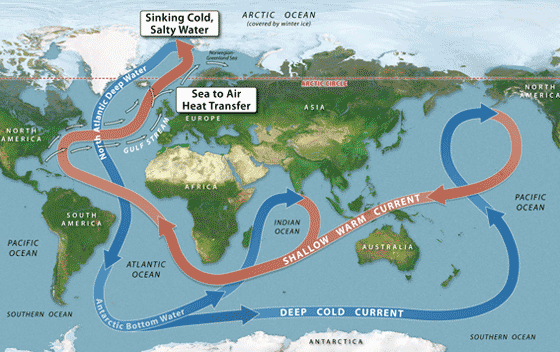
- The deep ocean currents are driven by differences in the water density, which is controlled by the temperature and salinity and is called thermohaline circulation.
- The circulation begins near polar regions, of the downwelling where ice formation leaves the water saltier and denser leading to the sinking.
- This underwater current moves in a single and continuous belt across the different oceans.
- They are connected to surface water currents in the regions of upwelling.
- They are also called Great Ocean Conveyor belts.
Atlantic Meridional Overturning Circulation (7:46 PM)
- AMOC is a part of the thermohaline circulation, in the Atlantic ocean.
- The recent report of the IPCC, talks about the weakening of AMOC, due to global warming.
- Factors responsible for the weakening
- (a) The temperature difference between the tropical and polar regions is decreasing due to the warming of the arctic region.
- This weakens the north Atlantic drift.
- (b) The excessive addition of freshwater due to increased melting of ice in polar regions.
- This reduces downwelling as the freshwater is less dense.
- Impacts
- (a) Western European countries will experience harsh winters and frozen ports.
- (b) Western parts of Oceans in the tropical regions, will experience a rise in sea levels.
- (c) Increased occurrence of cyclones in tropical waters.
- (d) Disturbance of fishing zones.
- (e) Disturbance of marine ecosystem.
- Water Mass (7:53 PM)

- It is a body of water with uniform characteristics of temperature and salinity.
- They are three types:
- (a) surface water mass- For example, Antarctic Surface Water mass
- (b) Intermediate water mass: For example Sub tropical Intermediate water mass of the Atlantic Ocean.
- (c) Deepwater mass: For example, North Atlantic Deep Water Mass
- water mass helps in the generation and maintenance of thermohaline circulation.
- they result in upwelling and downwelling.
- The movement of water mass helps distribute temperature, salinity, and oxygen.
- The uniformity of conditions, within water mass, supports plankton and coral growth.
The Topic for the next Class: El Nino and the related phenomena